Capped Bust Half Dollars
Overton Varieties Explained - A Practical Start for Bust Half Collectors
A beginner-friendly way to understand die marriages and start attributing Overton varieties.
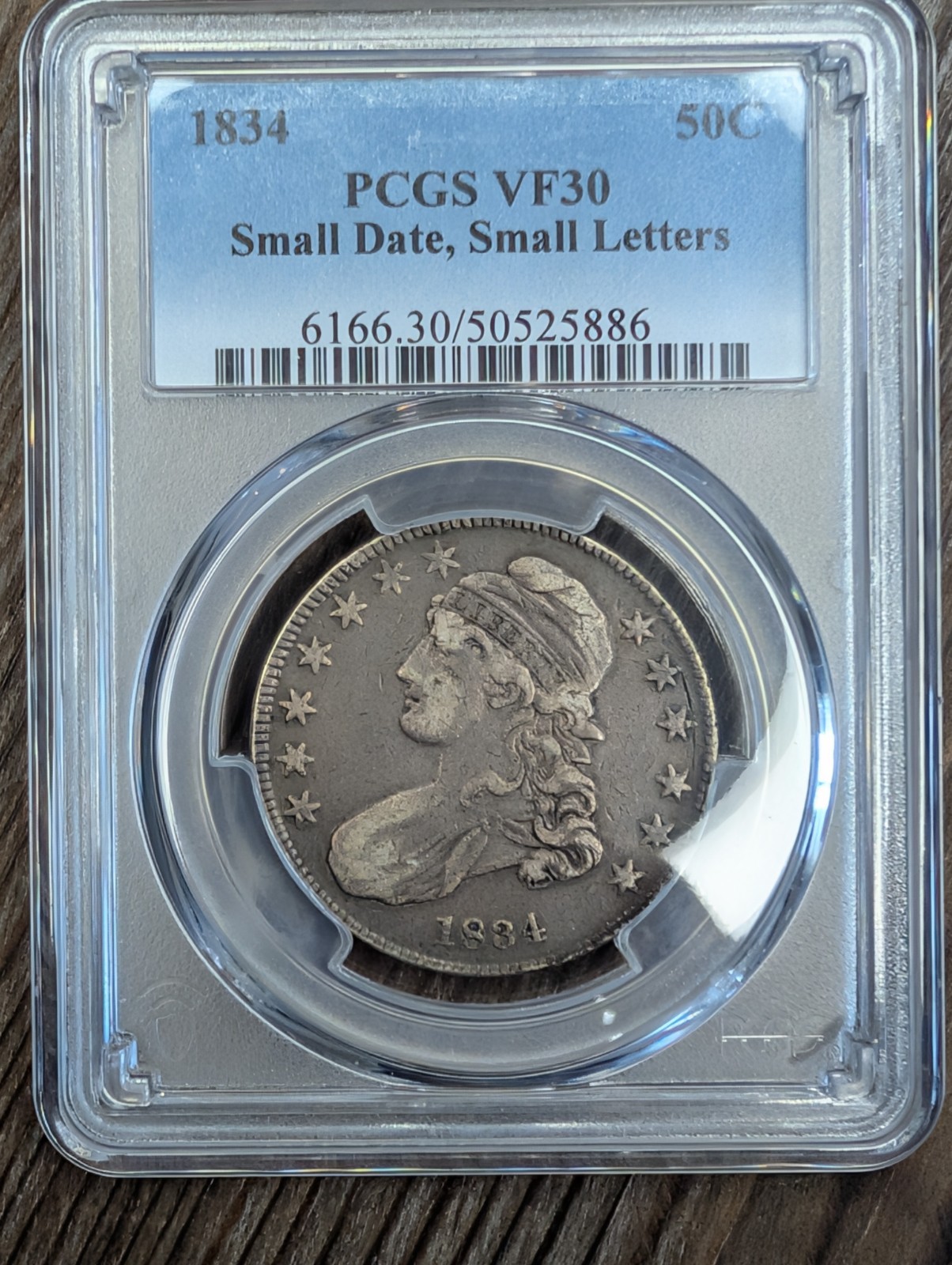
Capped Bust half dollars can look deceptively straightforward. At first glance, many dates seem nearly identical: the same Liberty portrait, the same eagle reverse, and the same basic design. But beneath that shared appearance is a detailed world of individually prepared dies, small design differences, and die pairings known as die marriages.
For collectors, learning Overton varieties is the standard way to explore that world. It can add a satisfying research dimension to a Bust half collection, whether you own a single circulated coin or are building a specialized date-and-variety set. The key is to start with a practical goal: learn to identify the coin in front of you accurately before worrying about rarity, registry points, or market value.
This guide explains the basic language of Overton attribution and offers a repeatable method for beginning collectors.
What Is an Overton Variety?
An Overton variety is an identified die marriage of a Capped Bust half dollar. The system is associated with Al C. Overton’s reference work on early half dollars, which organized known die pairings using “O” numbers.
A typical attribution may look like O-101, O-102, or O-110a. The number identifies a particular combination of one obverse die and one reverse die for a specific date.
That distinction matters. An Overton number does not simply mean “a variety of the 1827 half dollar,” for example. It identifies the exact die marriage used to strike that coin.
In practical terms:
- An obverse die struck the Liberty side.
- A reverse die struck the eagle side.
- A die marriage is one specific pairing of an obverse die with a reverse die.
- An Overton number labels that identified pairing.
- A die state describes how those dies changed through use, cracking, clashing, lapping, or other wear.
Collectors often shorten “Overton variety” to “Overton,” “O-number,” or “die marriage.”
A Bust half dollar can share the same date, denomination, and general design as another coin while being a completely different Overton marriage.
Why Capped Bust Halves Have So Many Varieties
The Capped Bust half dollar series was produced before modern die-making methods created a high degree of uniformity. Each working die was made and finished by hand. Small differences naturally appeared in lettering, stars, date placement, dentils, eagle details, and other design elements.
When a die failed or wore out, the Mint could pair the remaining usable die with another die. One obverse die might therefore be used with more than one reverse die, or one reverse could appear with multiple obverses. These changing pairings created the die marriages collectors study today.
This does not mean every small mark is a new variety. Many apparent differences are caused by circulation damage, cleaning, corrosion, adjustment marks, strike weakness, toning, or later die deterioration. Good attribution depends on separating intentional die characteristics from post-Mint changes.
Obverse Dies: What to Study on the Liberty Side
The obverse is usually where beginners begin, because date placement and star positions are among the easiest diagnostics to see. An attribution guide may describe relationships such as:
- The position of the date relative to the bust, dentils, or drapery.
- Whether certain digits are high, low, close together, widely spaced, tilted, or repunched.
- The position of stars in relation to Liberty’s cap, curls, or dentils.
- The size, shape, and placement of star points.
- The shape of individual date numerals.
- Die cracks through stars, the date, Liberty’s portrait, or the field.
For example, two obverses may both read the same date, yet one may have a noticeably higher final digit or a star that points toward a different feature of the cap. Those relationships can be more useful than trying to judge tiny absolute measurements from a photograph.
Obverse Diagnostics Are Usually Comparative
A single feature rarely proves an attribution by itself. A date that looks “high” may actually be the result of a tilted photo. A worn star may appear differently shaped because of circulation. Instead, match several features:
- Date position.
- Star placement.
- Digit style and spacing.
- Portrait details.
- Confirming die cracks or clash marks, if visible.
The more independent diagnostics agree, the more confidence you can have in the attribution.
Reverse Dies: The Eagle Side Often Confirms the Marriage
The reverse of a Capped Bust half dollar contains an equally useful set of clues. Common reverse diagnostics include:
- The position of letters in UNITED STATES OF AMERICA.
- The spacing and shape of letters in 50 C.
- The placement of the scroll and its ends.
- The relationship of arrowheads to letters or leaves.
- The number, shape, and position of berries and leaves in the olive branch.
- The arrangement of feathers, shield lines, and talons.
- Die cracks across the legend, shield, scroll, or fields.
Some reverse dies are especially recognizable because of a distinct misplaced berry, unusual letter spacing, a broken letter, or a prominent crack. Others require closer comparison because they share broadly similar layouts.
For a beginner, the best practice is to attribute both sides independently before declaring a marriage. If you think the obverse matches one listing but the reverse matches another, stop and recheck. You may be seeing a similar die, a later die state, a damaged coin, or an attribution error.
Understanding Die Marriages
A die marriage occurs when a particular obverse die and reverse die were paired in the coining press. If obverse die A was paired with reverse die 1, that is one marriage. If the Mint later paired obverse die A with reverse die 2, that is another marriage.
This explains why the same obverse may appear in more than one Overton number.
Think of it this way:
| Component | Example Concept |
|---|---|
| Obverse die | One specific Liberty-side die with its own date and star placement |
| Reverse die | One specific eagle-side die with its own lettering and leaf arrangement |
| Die marriage | The pairing of that particular obverse and reverse |
| Overton number | The catalog label assigned to that marriage |
| Die state | The stage of wear or damage visible on the dies during their use |
The marriage is the foundation of an Overton attribution. Die state is an additional refinement.
Prime Die States and Later Die States
A die changes as it is used. Early in its working life, it may show sharp details and no visible cracks. As production continues, the die can develop cracks, clash marks, polishing lines, lapped areas, or worn details. Collectors describe these stages as die states.
A prime die state generally refers to an early state of a die marriage, before major visible deterioration or distinctive later changes. A later die state shows evidence of continued use, such as:
- New or enlarged die cracks.
- Cracks extending into letters, stars, or devices.
- Die clash marks caused when obverse and reverse dies struck each other without a planchet between them.
- Lapping or polishing that weakens design details.
- Rust, chips, breaks, or swelling in the die.
- Progressive loss of fine detail.
Some collectors use specialized die-state terminology, including early, middle, late, and terminal states. The exact labels can vary by reference and collecting community, so it is wise to describe what you see rather than rely only on a label.
For example: “A reverse crack runs from the scroll toward the right side of the shield” is more useful than simply saying “late die state” without supporting detail.
A later die state can be interesting and sometimes scarce, but it does not automatically make a coin valuable. Desirability depends on collector demand, rarity, grade, originality, eye appeal, and the particular marriage or die state involved.
How the O-Number Convention Works?
Overton numbers are assigned within each date. An O-101 for one date is not related to an O-101 for another date; the date is always part of the identification.
Write attributions clearly:
- 1823 Capped Bust half dollar, O-101
- 1827 Capped Bust half dollar, O-102
- 1834 Capped Bust half dollar, O-105
Letter suffixes may appear in some attributions, such as O-110a. These suffixes can indicate a recognized die-state distinction or related listing convention in the reference system. Do not assume every letter suffix has the same meaning across all dates without consulting the relevant reference.
When cataloging your own coins, include the full date, Overton number, die-state information if known, grade or condition notes, weight, diameter, and any concerns about cleaning, damage, or authenticity.
A Repeatable Overton Attribution Checklist
Attribution becomes easier when you use the same sequence every time. Avoid jumping straight to a favorite variety based on one exciting-looking feature.
1. Confirm the Basics First
Before studying die diagnostics, verify that the coin is plausibly a Capped Bust half dollar of the expected date and design type.
Check:
- Date and denomination.
- Diameter and weight against reliable reference standards.
- Edge lettering and edge appearance.
- General style of Liberty, stars, eagle, scroll, and lettering.
- Signs of casting, tooling, added details, altered dates, or other authenticity concerns.
If a coin seems suspicious, do not rely on variety attribution to prove authenticity. Seek evaluation from a qualified authenticator, experienced early-half specialist, or reputable third-party grading service.
2. Photograph Both Sides Clearly
Use straight-on, high-resolution images with even lighting. Photograph:
- Full obverse.
- Full reverse.
- Date close-up.
- Star groups.
- Key lettering areas.
- Arrowheads, berries, leaves, and scroll ends.
- Any suspected die cracks, clash marks, or breaks.
Avoid relying on heavily angled images. Shadows can create false “cracks” and make digit placement look different.
3. Identify the Obverse Die
Compare the date, stars, and portrait placement to a reliable attribution reference. Record the strongest matches rather than making an immediate conclusion.
Useful notes might include:
- “Final date digit appears close to bust.”
- “Star 7 points toward cap.”
- “Date is centered differently from candidate A.”
- “Possible crack through lower stars.”
4. Identify the Reverse Die
Now compare reverse diagnostics separately. Focus on letter spacing, arrowheads, leaf positions, berries, shield details, and visible cracks.
Do not force the reverse to fit the first obverse candidate. The correct attribution should work on both sides.
5. Confirm the Marriage
Once you have likely obverse and reverse die matches, confirm that the reference lists them together as the same O-number.
This is the crucial step. A coin may resemble a known obverse and a known reverse but still require closer study if the pairing does not match the listed marriage.
6. Determine the Die State, If Possible
After identifying the marriage, compare visible cracks, clashes, lapping, and breaks with die-state descriptions or images.
If uncertain, record the marriage without a die-state designation. A correct basic O-number is better than an overconfident and unsupported die-state claim.
7. Preserve Your Evidence
Keep your photos and notes. If you later consult another collector or specialist, clear images and a written list of diagnostics make the discussion much more productive.
Reference Tools That Make Attribution Easier
A serious printed reference remains one of the most useful tools for Bust half attribution. Look for a current edition or respected revision of the standard Overton reference, especially one with photographs, die descriptions, rarity information, and die-state coverage.
Other useful tools include:
- High-resolution images from reputable auction archives.
- Educational resources from established early American coin organizations.
- Attribution guides prepared by recognized specialists.
- A loupe or stereo microscope for close examination.
- A scale accurate to at least 0.01 gram.
- Calipers for diameter checks.
- Good photography equipment or a phone mount with controlled lighting.
Use online images carefully. Auction photographs can differ in color, contrast, orientation, and lighting. A feature visible in one image may disappear in another. Whenever possible, compare multiple examples of the same listed marriage.
For broader study of the series, see the entire capped bust series.
Does an Overton Attribution Make a Coin More Valuable?
Not automatically.
An Overton number identifies a die marriage; it does not guarantee rarity, demand, or a premium. Some marriages are widely available, while others may be much more difficult to locate. Even a scarce marriage can bring limited interest if the coin is heavily damaged, harshly cleaned, poorly struck, or unattractive.
Value should be separated into several different concepts:
- Face value: The legal denomination, 50 cents.
- Melt value: The approximate value of the coin’s silver content, which changes with silver prices.
- Retail asking price: What a dealer asks; it is not necessarily the amount a buyer will pay.
- Auction result: The hammer price plus or excluding buyer’s premium depending on how the result is reported; it reflects one specific sale.
- Estimated value: An informed opinion based on recent comparable transactions, grade, originality, rarity, demand, and market conditions.
A common Overton in pleasing, original condition may be more marketable than a rare marriage with major problems. Likewise, a premium attached to a recognized variety can vary substantially by grade and collector interest.
Treat attribution as knowledge first. If it also affects market value, verify the marriage, assess the coin’s condition honestly, and compare genuinely similar examples.
Common Beginner Mistakes to Avoid
- Attributing from only one side of the coin.
- Treating every scratch or dark line as a die crack.
- Confusing post-Mint damage with a die variety.
- Assuming a rare-sounding O-number is automatically valuable.
- Relying on one online photo or one seller’s attribution.
- Ignoring authenticity because the variety seems convincing.
- Calling a coin a rare die state without matching documented diagnostics.
- Cleaning a coin to make details easier to see.
Cleaning can permanently reduce collector appeal and may make attribution harder by altering surfaces. If dirt or residue obscures important details, consult a knowledgeable professional before attempting any conservation.
Start with Observation, Not Rarity
Overton attribution rewards patience. Begin by learning the difference between a die, a die marriage, and a die state. Then use clear photographs, compare both obverse and reverse diagnostics, and confirm the pairing in a reliable reference.
You do not need to memorize every O-number to enjoy Capped Bust halves. A careful, repeatable process will build confidence coin by coin—and help you recognize when a second opinion is the smartest next step.
Frequently Asked Questions
What does O-101 mean on a Capped Bust half dollar?
O-101 is an Overton catalog number for a specific die marriage within a particular date. The date must always be included, because O-101 for one year is not the same marriage as O-101 for another year.
Is every Capped Bust half dollar an Overton variety?
In the broad sense, every genuine Capped Bust half dollar was struck from a particular obverse-and-reverse die pairing and can potentially be attributed to a die marriage. However, not every coin has enough visible detail for confident attribution, especially if it is worn, damaged, corroded, or poorly photographed.
What is the difference between a die marriage and a die state?
A die marriage is the pairing of a specific obverse die with a specific reverse die. A die state is the condition or stage of those dies during use, reflected by cracks, clash marks, lapping, breaks, and other progressive changes.
Can I attribute an Overton variety from a slab label alone?
A third-party grading label may include an attribution, but collectors should still examine the coin and understand the diagnostics when possible. Labels can be helpful starting points, yet the underlying coin, reference work, and visible evidence remain important.
Does a rare Overton variety guarantee a premium?
No. A premium depends on more than rarity. Condition, originality, eye appeal, collector demand, authentication, and the availability of comparable examples all matter. A rare attribution should be verified before it is used in a buying or selling decision.
A Practical Research Kit for First Attributions
Start with the marriage, not the suffix. The most recently verifiable edition of the principal reference is Donald L. Parsley’s United States Early Half Dollar Die Varieties, 1794–1836, 5th edition (2014), a 701-page hardcover with photographs and die-state coverage. Bibliographic listing · JRCS discussion of the fifth edition
For a first pass, use the Overton/Parsley book to identify the obverse and reverse, then compare your coin with several well-photographed certified examples in established auction archives. Heritage’s archive illustrates how catalogers document an O-number, visible diagnostics, and an early versus later state; Stack’s Bowers provides another specialist catalog example. Archive access and listings checked August 10, 2026.
Read Letter Suffixes Carefully
An attribution such as 1819 O-109a may identify a recognized later state, but collectors should not assume that every letter suffix works identically for every date or reference. Heritage’s 1819 O-109 listing distinguishes O-109 from the later O-109a by specific reverse defect lines, while the Bust Half Nut Club’s dedicated die-state project uses a different format: year, O-number, decimal point, and a die-state number. Bust Half Nut Club die-state reference description
That is why a careful catalog entry should read something like:
1819 Capped Bust half dollar, O-109; later-state attribution not confirmed.
This wording preserves the confirmed marriage while avoiding an unsupported claim about the die state.
Repeatable Attribution Workflow
- Record the coin exactly as seen. Photograph both full sides plus the date, stars, denomination, arrows, leaves, berries, lettering, and any suspected cracks or clash marks.
- Match the obverse first. Compare date placement, digit shapes, star positions, and portrait details against the reference photographs and descriptions. The fifth-edition reference description notes that its enlarged photographs are intended to aid visual attribution.
- Match the reverse independently. Check legend spacing, arrowhead and leaf relationships, denomination details, and diagnostic cracks before looking for a marriage number. A Heritage O-109 catalog description demonstrates this kind of reverse-based confirmation.
- Confirm that the two dies are paired in the reference. An obverse resemblance and a reverse resemblance do not establish a marriage unless the reference joins those dies under the same O-number.
- Only then study die state. Treat cracks, clashes, lapping, and breaks as supporting evidence, and write down the exact feature you see rather than relying only on “early” or “late.” The Bust Half Nut Club’s die-state project specifically tracks the progression of cracks and other features on the working dies.
- Seek a second opinion when the coin is worn, altered, damaged, or suspicious. Variety attribution is not a substitute for professional authentication.
Keep Attribution and Value Separate
An O-number identifies a die marriage; it does not by itself establish rarity, grade, originality, collector demand, or market value. Auction archives can help document comparable offerings, but each result reflects one particular coin, grade, attribution, venue, and sale date. Heritage’s O-109 archive record · Stack’s Bowers O-101a catalog example
For that reason, record face value, metal-content value, dealer asking price, auction result, and your estimated value as separate categories rather than treating any one number as the coin’s automatic worth.
Research sources
- The fifth-edition reference description notes that its enlarged photographs are intended to aid visual attribution.
- JRCS discussion of the fifth edition
- Heritage’s O-109 archive record
- Stack’s Bowers O-101a catalog example
- The Bust Half Nut Club’s die-state project specifically tracks the progression of cracks and other features on the working dies.